E1, E2, E3, and D2 NSF ratings explained. What each code means, when a rinse is required, and where each product belongs in your plant.
The codes on your soap and sanitizer labels make a difference between a hand hygiene program that passes an audit and one that gets written up.
You've seen the codes — E1, E2, E3, D2 — printed on soap labels, tucked into spec sheets, maybe circled by an auditor at some point. We get this question all the time, from brand-new sanitation supervisors and twenty-year food safety veterans alike. These ratings are one of the most useful tools in your hand hygiene program.
We are going to cover what each rating means, when a rinse is required, and where each product belongs in your facility.
First: who's behind the ratings
These classifications come from the NSF Nonfood Compounds Registration Program — the program NSF took over from the USDA. It covers products used in and around food processing that aren't food themselves: soaps, sanitizers, lubricants, cleaners.
An NSF-registered product has been independently reviewed for its formulation and intended use in a food environment. When your auditor sees the NSF mark and the correct category code, that's documentation working in your favor. When they see an unregistered product at a handwash station, that's a finding waiting to happen.
What do the ratings mean?
NSF manages the nonfood compound program previously established by the USDA. NSF-registered products provide additional assurance of efficacy and compliance.
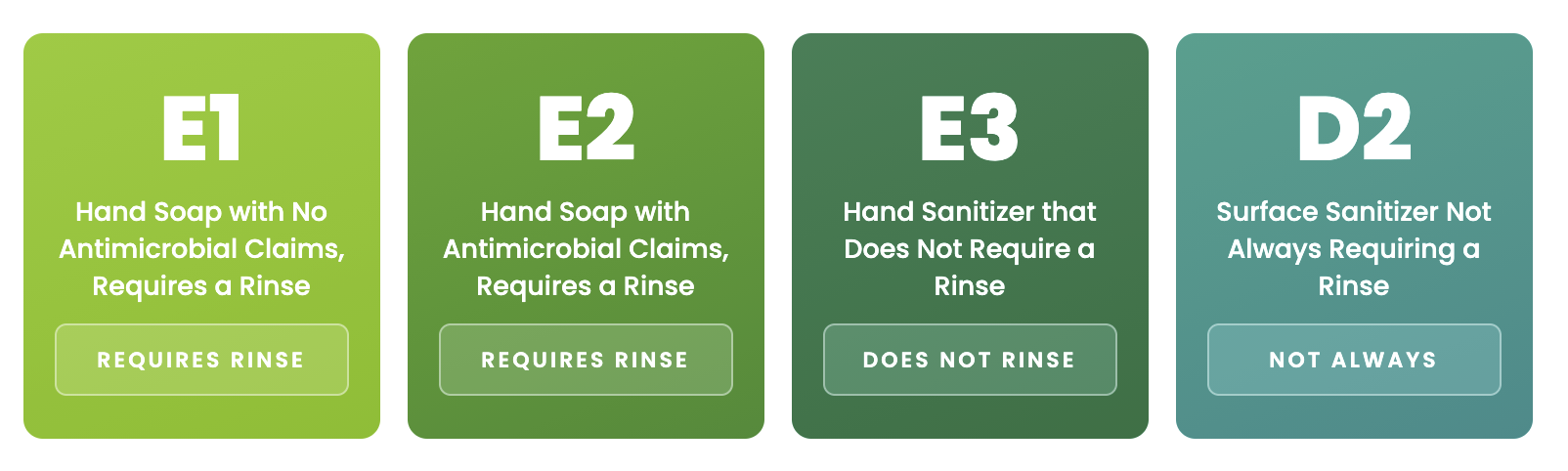
NSF nonfood compound categories for hand soaps and sanitizers in food processing environments.
Each rating explained
E1 — General hand soap
A standard handwashing soap with no antimicrobial claims. It cleans, removing soil, grease, and organic matter — but it isn't formulated to kill bacteria. It always requires a rinse. E1 soaps fit non-critical wash points: offices, restrooms outside production, and areas where your SOP doesn't specify an antimicrobial.
E2 — Antimicrobial hand soap
This is the workhorse of food processing handwash stations. E2 soaps clean and carry antimicrobial claims, and they also require a rinse. If your employees handle food or food-contact surfaces, E2 is typically what your program should specify at entry points to production. Many audit schemes and customer specs call for E2 by name — check yours.
E3 — Hand sanitizer
E3 products are leave-on sanitizers — no rinse required. Important nuance: E3 is not a substitute for handwashing. It's the step after a proper E1 or E2 wash, or a supplement between washes. If sanitizer dispensers are standing in for soap and water at your production entrance, that's a gap an auditor will catch.
D2 — Surface sanitizer
D2 sanitizer steps away from hands entirely. It's an antimicrobial for equipment and environmental surfaces, and it doesn't always require a rinse — it depends on the product, its concentration, and whether the surface is food-contact. This is where reading the label and following the validated use dilution matters most. The wrong concentration on a food-contact surface can turn a sanitizing step into a chemical residue problem.
The 10-second audit check
Walk your hand-washing stations. Every dispenser should hold a product whose NSF code matches what your SOP specifies for that location — E2 at production entrances, E3 as the follow-up step, never E3 alone where a wash is required. If a label and an SOP disagree, one of them needs to change before your next audit does it for you.
Hand hygiene beyond the audit
Hand hygiene is one of the highest-leverage, lowest-cost controls in your entire food safety program. Getting the right product class at the right station is how you keep pathogens off the product without slowing your line down. The ratings exist so you don't have to take a supplier's word for it.
We've walked hundreds of handwash stations across food facilities, and the most common issue is the wrong product or the right product in the wrong place. A five-minute review of your dispensers against your SOP usually finds it.
Not sure your stations match your spec?Amerisan's food safety specialists can review your hand hygiene program — station by station, product by product — and make sure every dispenser holds up under audit. We keep our promises, and we keep you safe. |